sábado, 17 de marzo de 2018

martes, 27 de febrero de 2018
: Deep Culture in the Elementary Classroom
I'm thinking how I can prepare an English lesson based on the intercultural students in the classroom. I can imagine many different nationalities in the class and all of them talking and sharing their traditions each another, but that isn't sufficient how a cultural lesson. Like the text says we need start to go inside the culture and not think only the basic or simple things, all the children maybe know how is a country, where is in the map and some simple traditions, but learn about the thoughts, paradigms, and feelings of these people can give us a deep knowledge of this country.
It's interesting to develop a structured plan and the guide of Madeleine Hunter is great. We can follow the international standards addressed and give a time to every skill based on the different cultures. I can imagine asking with time to some students of the same culture in the intermediate level prepare "Your own culture day" They can start with basic traditions like food, dances, typic clothes, but then they must share some paradigm or some personal story with the lesson. They will have a time to questions and answers, analyzing what the other students would do in this situations and share their own paradigms, traditions or thoughts in the same situations, then they can be ready to write their reflections about the learning and then read it. It's important to remember that the culture is more than clothes or food, is how the people think and live and I want to have some lessons where we can share deeply our feelings for our culture and learn to others. In the same way, we can improve the four skills (write, read, speak and listen) based on the culture of one or some students. Depending on how many students are in the classroom we can have many lessons in the month learning about their own cultures and improving the skill in the language.
I'm happy because we have the opportunity to teach different cultures in my country because we are receiving a lot of foreign and we are having a fun multicultural classroom in these days... Can be a great time teaching a multicultural class...
miércoles, 21 de febrero de 2018
Cultural - Psychologic
I feel like a child learning a lot of things thesedays ... watched the video of Cultural and Psychology made me think about how we need to be prepared to be in front of a lesson. I'm honest ... we can think how to be a good teacher and share love and knowledge with them, but in my case, I never thought the lot of tools that we need to prepare a plan of the lesson and give an integral lesson That is not only an English lesson, that is a life lesson. We need to know about their traditions, their paradigms, their norms, their cultural and now, how these things affect their Psychology state.
When I watched the video I remembered a Cultural and Psychology situation in my country.
In 1973 we had a Military Coup, this day our country separated in pro Coup and against Coup and they are fighting until today for that. Sadness, the people cannot forget these days, and the hate and suffering are constant.
Today, I can say that is a real cultural and Psychology situation, all the things are based on that, are you rightist or leftist? That need to be a personal condition of every Chilean and the big problems like suffering and bad communication came from these days. I don't like to think that the people can learn about my country remembering these days, but I can't forget that occurred and as Chileans, we need to have a choice what way to follow. To me is a challenging topic because we have differences in the jobs, schools, social meeting, and the normal life all the time... depending on which side you support you will see that people will be near you. You can lose very good friends even family, you can live with depression for the political reason because I can understand... many people have suffered and I think many people will continue suffering for that. In Chile we say "in the social meeting we can't talk about religion, sport and politics"... you always finished angrily with someone...
martes, 20 de febrero de 2018
Difference Manners
Really, we have Difference in Manners, when I watched the video from BYU-Idaho I saw how we can have many differences among the other cultures and Chileans in my case but some similar too.
We can't burp in public, that is very bad or embarrassing, but we can't put our elbows on the table too that is bad education.
I don't know if is correct or not, but many people resting with their feet up. It's very common, especially men in their home.
Chilean give kisses all people, no matter where are they from, when we meet someone we give a kiss, can be men to men, women to women or men to women we always do it.
A very interesting thing in Chile is when you go some house, the family invites to you to eat... sometimes the people say "oh, no thank you", the Chilean insist again and invite you to eat again... maybe you will say again... "I'm ok, thanks" but the Chilean will say again, do you want to eat? and then you say "ok, thanks, let's eat"... I don't know why, but we wait for the third invitation to accept.
In Chile, we give tip all the time to the service in a restaurant and we have a moral law that to pay 10% of the total of the check to them.
Personally, I love the tradition from Asia to remove our shoes... As a family we try to do it often, I like the reason that the Asian give to that, but in Chile almost nobody does it.
I wanted to share these differences because I think is very interesting share with you some of my differences and I hope I can learn from your differences...
I want to finish today with this video... it's about the Greeting Etiquette from around the World... I hope you enjoy it... See you!!!
Cross-Cultural Students in the Classroom
I can imagine the fun with "Cross-Cultural Students in the Classroom", Yes,
we can think that is stressed to having multicultural students in the class,
but we can enjoy and improve the lesson a lot with them... When I was watching
the video first I laughed a lot thinking about my own traditions. Talking about the respect with the
teachers. In the bad economic situation
schools, the students are having a more daring attitude towards teachers
today. I can see how this important
tradition to me, is changing toward bad.
As the teacher said, they don't want to pay attention in the classroom,
some of them are having a hard fight with the teacher for the insistence and
the drugs.

However, Chile like a country
is yet respectful to the teacher and general people.
If we are
late to the lesson is terrible for us, because is showing a bad education. It needs to ask permission to go to the
bathroom in the school. In the normal
life, they need to ask the parents permission for having a date or meet with
their friends. Well, I'm talking about
the teenager, because the adults are different.
I insist
that to us, as a teacher to foreign people is essential to learn and be
prepared even for our first lesson. We
need to ask for the list of students early for know who are they, where are
they from, what are their traditions and norms, etc. It's our responsibility make a good environment
for the class. All of us are different,
but they are some of these differences are more important than others, the
cultural differences are one of the very important in the classroom.

viernes, 16 de febrero de 2018
Attributional Tendencies
Attribute. This is the first words that I thought trying to understand this topic. In the dictionary says "To consider a person or thing as the author or cause of something, generally based on conjecture" or "Award a quality to a person or thing". Sincerely, this is a great topic and it was interesting to give a name a normal action to every person do in this world. All the people have the Attribution Tendency as the Teacher said in the video and discover when is good or when is bad is a big challenge, I don't know yet if that has something good or all is bad.

The second thing that I thought it was why we have or use this attribution and "Proud" was a very good answer to me. The proud is on the defensive all the time. "I want to be a good person, I don't want to make mistake, I want all the people to love me"..., but when that doesn't occur the proud starts to think "Why?" Why did I?, Why don't have friends? why, why, why... and we need answers and these answers are Attributional Tendencies. Well, I need to justify why something is like that or why something doesn't work... and the proud starts to work... "It wasn't my fault, I did my best"... "Oh, thanks, I efforted a lot, I happy with my success"... "This world is a disaster the people don't understand the basic things to live"... etc. We aren't the guilt of all the things that occur around us, but we aren't the reason for the success to something either all the time. Maybe if we start to recognize all our actions with honesty and humility, this kind of excuse wouldn't be necessary.
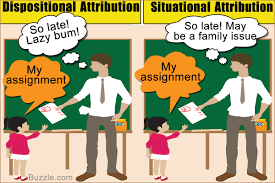
How can help me that in my lesson... first, accept that many things occur but they aren't my fault all the time. Second, the students need to understand that the teacher wants to help them and he/she isn't the enemy. Third, think, why that is occurring at this moment?. Fourth, we have much prejudice, we need to stop with that, and fifth, start to choose better and think more about our actions.
I think I need to read and learn more about this topic, because like the teacher said in the video, it's a very deep thing... It's fun, but in this moment I think, I'm attributing my basic post to my small knowledge and I'm justifying haha... See you!!!
The second thing that I thought it was why we have or use this attribution and "Proud" was a very good answer to me. The proud is on the defensive all the time. "I want to be a good person, I don't want to make mistake, I want all the people to love me"..., but when that doesn't occur the proud starts to think "Why?" Why did I?, Why don't have friends? why, why, why... and we need answers and these answers are Attributional Tendencies. Well, I need to justify why something is like that or why something doesn't work... and the proud starts to work... "It wasn't my fault, I did my best"... "Oh, thanks, I efforted a lot, I happy with my success"... "This world is a disaster the people don't understand the basic things to live"... etc. We aren't the guilt of all the things that occur around us, but we aren't the reason for the success to something either all the time. Maybe if we start to recognize all our actions with honesty and humility, this kind of excuse wouldn't be necessary.
How can help me that in my lesson... first, accept that many things occur but they aren't my fault all the time. Second, the students need to understand that the teacher wants to help them and he/she isn't the enemy. Third, think, why that is occurring at this moment?. Fourth, we have much prejudice, we need to stop with that, and fifth, start to choose better and think more about our actions.
I think I need to read and learn more about this topic, because like the teacher said in the video, it's a very deep thing... It's fun, but in this moment I think, I'm attributing my basic post to my small knowledge and I'm justifying haha... See you!!!
jueves, 15 de febrero de 2018
Personal Space
It was great to read and learn about this topic. Personal Space... I have a big bubble around my space and sometimes I feel angry because not many people respect it.
Learn about the Zone Distances was so interesting... because I could identify it in my personal experience... and with practice, I should identify the attitude from others and I think... this is the idea. It's great to recognize with names like Intime Zone, Friend Zone, Social Zone and Audience Zone.

I believe that how all the people have this bubble around them when it's talking about that Latins or Asians are familiar with small space, I think that not means that they like it. I try don't take a bus during peak hours, it's terrible in Chile... and the Subway is worse, not like Japan, but very similar and I think we will be like to Japan soon. Ok... as Latins we are more affective and close with others, but when we know these people.
How can affect me in the classes? That is one of the important things in the classroom, I can lose the confidence of some students if I don't respect his/her Personal Space. It's so important to know our students, they countries, traditions, paradigms, norms, economic situation, culture because sometimes a word or attitude can be a bad or sad moment in the lesson.
I'm asking what would happen if all the people reading texts like that?... How would they act in some situations if they know other cultures?... How can I change the mind and attitude to others in difficult moments? I enjoyed a lot reading "Personal Space Ownership" I hope all of you can read it...
http://westsidetoastmasters.com/resources/book_of_body_language/chap9.html
“Individualistic” and “Collectivistic” Values
That is a big topic, how can I write about that if I have a lot of points to develop.
I want to start with Value, “Values” as used here includes beliefs, assumptions, and attitudes and the culture refers to the patterns of values and learned behaviors that are transmitted from generation to generation and this values have two elements Individualism and collectivism depending to every culture.
Individualism is near to the independence and self-sufficient. The U. S. is an individualist country. On the other hand, the Asian countries are collectivism because they think of the group, the society, their family instead of one person.
On based on this points I was thinking about my self, how I define me, individualist or collectivism. Sincerely, after pondering this table I found characteristic in both. I'm a Latin person, however, I think I'm individualist but this individualism helps me improve my group, my family, my religion, my society because I'm collectivism too. I believe that every person acts for they self-welfare, but in the same way they want to give something to others. For example, the Chinese School, (and it's the same in all Asia) the students work in a collectivism education, they think in their families, their school, their society, but they work hard because know without this effort they can't improve their lives. I can understand the system carry them in this way, but they do it for their own life the system obligates them to do it.

I had a Korean Teacher some years ago who told me that in her time in the school she waked up at 5:30 am, 7:30 she was starting the school's day, finish to 5:00 pm and then run to another institute that started to 6:30 pm finishing to 10:30 pm and he came back at home around 00:00 am every day, took a shower, prepared the things to the next day and she needed to study more at home for a time too, and she went to the bed at 1:00 am. She remembered a famous sentence of this time... "who sleeps more than 4 hours a day does not go to University"... I can't believe in this style of life and least how this school's knowledge doesn't give them the possibility to create and think freely.
I feel happy to learn the Church Educations System because I know is the correct way to improve our lives... every day I can see the hand of the Lord in this kind of education and how the world is changing unto this style of teaching. We can think, ponder, create, analyze and be an active participant in our education. I hope I can give this tools to my students.
I'm individualist but I know that my achievements will help to my family and society because like a member of the Church we know that the salvation is not individuality...
I want to start with Value, “Values” as used here includes beliefs, assumptions, and attitudes and the culture refers to the patterns of values and learned behaviors that are transmitted from generation to generation and this values have two elements Individualism and collectivism depending to every culture.
Individualism is near to the independence and self-sufficient. The U. S. is an individualist country. On the other hand, the Asian countries are collectivism because they think of the group, the society, their family instead of one person.
Continuum of Values
| |
|---|---|
Collectivistic
|
Individualistic
|
Interdependence
|
Independence
|
Obligations to others
|
Individual rights
|
Rely on group
|
Self-sufficiency
|
Adhere to traditional values
|
True to own values and beliefs
|
Maintain traditional practices
|
Continuously improve practices (progress)
|
Fulfill roles within group
|
Pursue individual goals/interests
|
Group achievement
|
Individual achievement
|
Competition between groups
|
Competition between individuals
|
Group or hierarchical decision-making
|
Self-determination and individual choice
|
Shame/guilt due to failing group
|
Shame/guilt due to individual failure
|
Living with kin
|
Independent living
|
Take care of own
|
Seek help if needed
|
Property shared within group
|
Strong individual property rights
|
Elders transmit knowledge (often oral)
|
Individuals seek knowledge (often textual)
|
Objects valued for social uses
|
Objects valued for technological uses
|
On based on this points I was thinking about my self, how I define me, individualist or collectivism. Sincerely, after pondering this table I found characteristic in both. I'm a Latin person, however, I think I'm individualist but this individualism helps me improve my group, my family, my religion, my society because I'm collectivism too. I believe that every person acts for they self-welfare, but in the same way they want to give something to others. For example, the Chinese School, (and it's the same in all Asia) the students work in a collectivism education, they think in their families, their school, their society, but they work hard because know without this effort they can't improve their lives. I can understand the system carry them in this way, but they do it for their own life the system obligates them to do it.
I had a Korean Teacher some years ago who told me that in her time in the school she waked up at 5:30 am, 7:30 she was starting the school's day, finish to 5:00 pm and then run to another institute that started to 6:30 pm finishing to 10:30 pm and he came back at home around 00:00 am every day, took a shower, prepared the things to the next day and she needed to study more at home for a time too, and she went to the bed at 1:00 am. She remembered a famous sentence of this time... "who sleeps more than 4 hours a day does not go to University"... I can't believe in this style of life and least how this school's knowledge doesn't give them the possibility to create and think freely.
I feel happy to learn the Church Educations System because I know is the correct way to improve our lives... every day I can see the hand of the Lord in this kind of education and how the world is changing unto this style of teaching. We can think, ponder, create, analyze and be an active participant in our education. I hope I can give this tools to my students.
I'm individualist but I know that my achievements will help to my family and society because like a member of the Church we know that the salvation is not individuality...
lunes, 12 de febrero de 2018
High and Low Tolerance with the Differences in Emotional Expressivity

What do we know about high tolerance and low tolerance?... We need to have the high tolerance for some difficult moments and low tolerance to bad things, however, I learned a new concept today... both can be good or both can be a little difficult...
When we talk about high and low tolerance in the Emotional expression we can see what is high and what is low...
High means be tolerance, we can accept and receive many feelings from others and we can accept them quiet, happy sharing with them these feelings with a good attitude. When we have low tolerance maybe they can't understand us and don't share with us our happiness or sadness.
Teacher Jefferson taught how in Sud-America the people express their feelings freely if they want to cry... crying; if they want to shout... they shouting and if they want to laugh they do it strong. On the other hand American, British, even Scandinavia have a low tolerance for the emotions and, although they can cry, shout or laugh in their homes, they don't do it in public.
That makes me a lot of sense. I'm a Latin woman and I can share all my feelings and emotions freely everywhere and with everyone... that is fantastic... I don't feel embarrassed, I don't feel fears... I know the people will cry, will shout, will dance, will sing or laugh with me because we are Latins... and yes, sometimes the low tolerance people is a little boring for us...
Like a teacher, I need to equilibrate these feelings and teach to my students the difference between the cultures and practice how we can accept us and respect us in our different moments in the classroom and the life.
Suscribirse a:
Entradas (Atom)